01 · MODEL CRYSTAL
ARGON GEOCHRONOLOGY · DIFFUSION INVERSION
Wunderkind
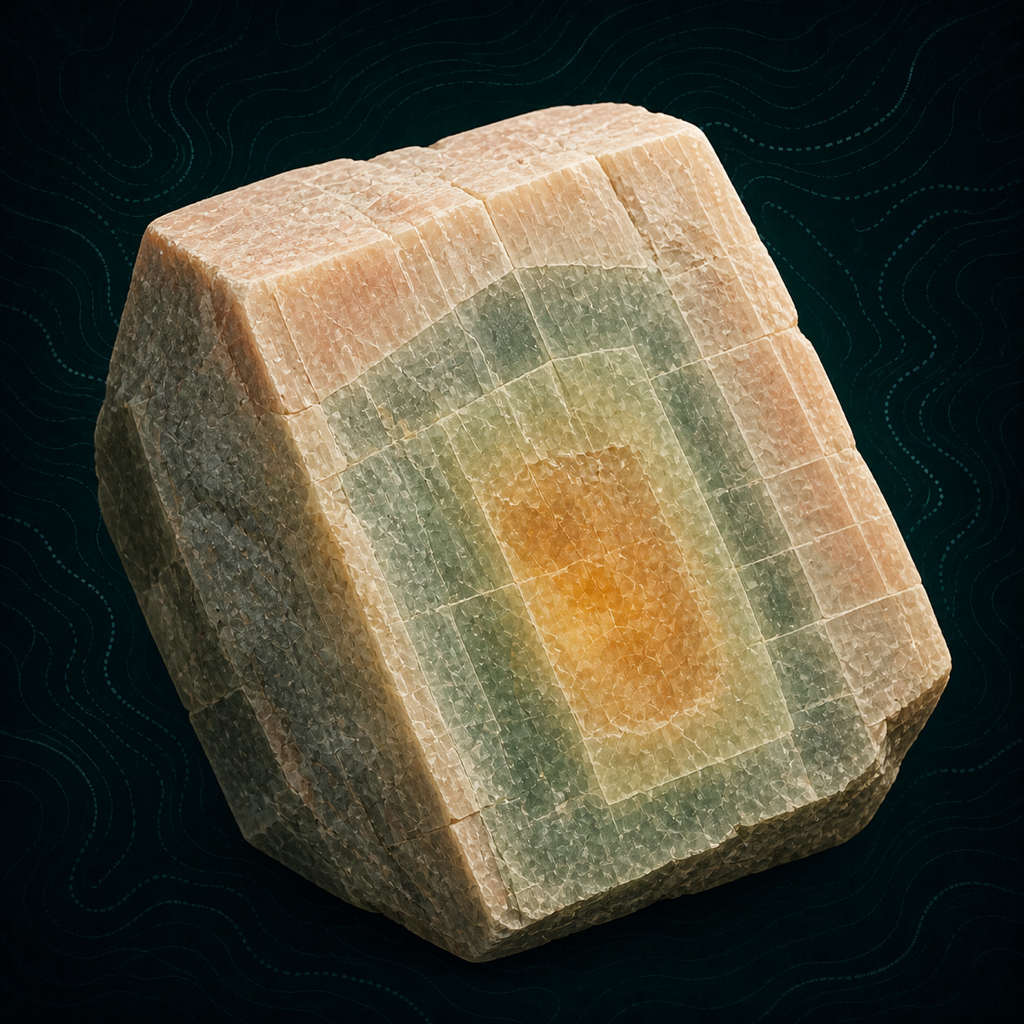
Turn a laboratory release pattern into a testable model crystal. Wunderkind fits multiple diffusion domains to measured 39Ar release, while keeping the choices behind the fit visible.
Follow the workflow
macOS · SPECIALIST SCIENTIFIC TOOL
WHAT IT DOES
Fit the release pattern, inspect the assumptions, then carry the model into thermal-history experiments.
02 · INVERSION
Choose what controls the fit.
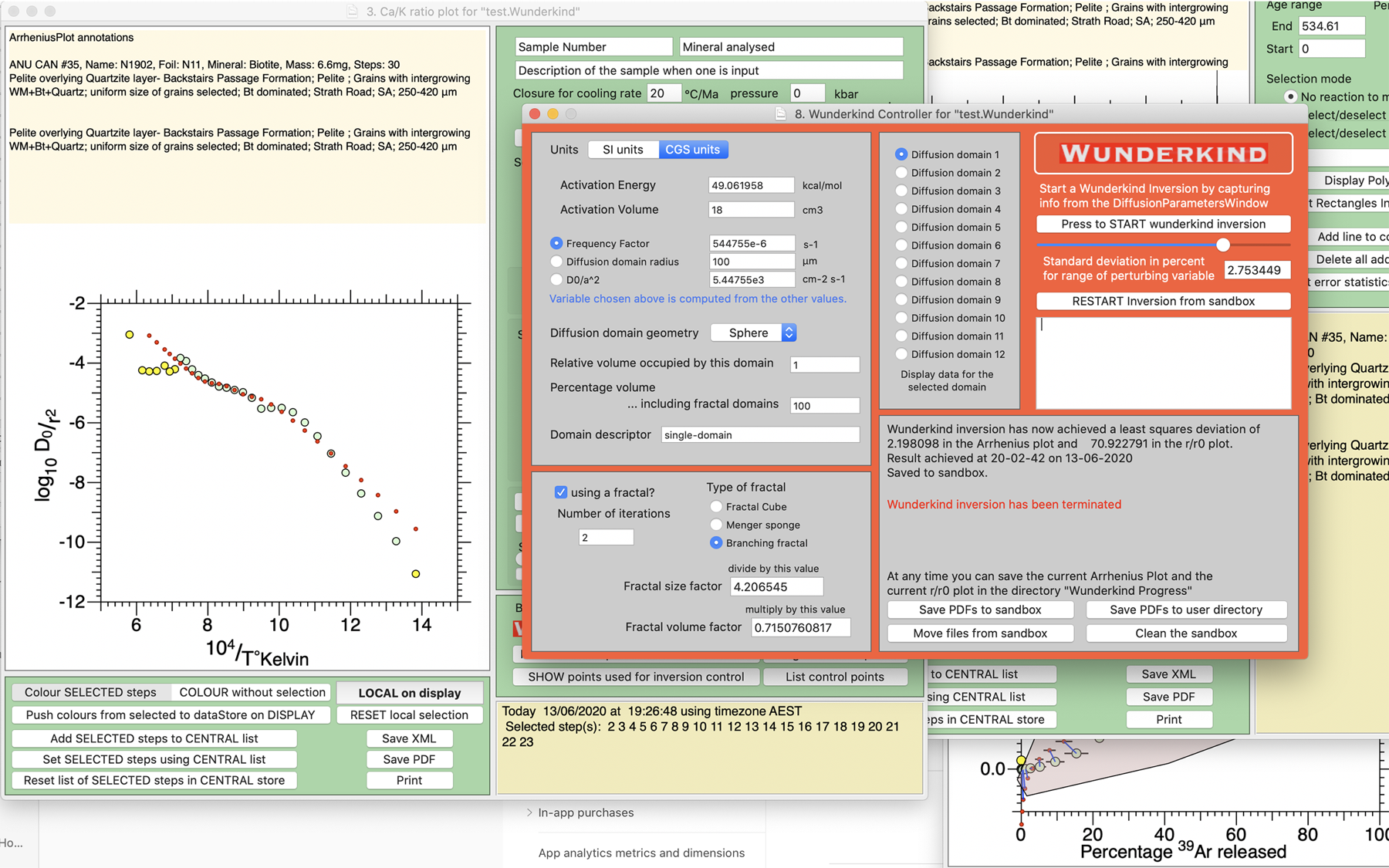
Start manually or from chosen Arrhenius lines, select the Arrhenius and r/r0 observations, and let the numerical search perturb the enabled parameters.03 · DIAGNOSTICS
See where the model succeeds.
Compare measured and calculated behaviour across Arrhenius, r/r0, domain and profile-release plots before accepting or revising a solution.THE SCIENTIFIC MODEL
A crystal represented as a collection of diffusion domains.
Wunderkind calculates diffusion through the imposed laboratory furnace schedule. A successful inversion is one whose calculated release pattern mimics the measured release of 39Ar.
- INPUT
- An XML
.Wunderkinddocument prepared in eArgon - CONSTRAINTS
- Chosen Arrhenius and r/r0 observations
- HANDOFF
- A domain model ready for simulation in MacArgon
A TRACEABLE WORKFLOW
From measured gas release to a model you can challenge.
The starting domain population is a seed for numerical search—not an independently established physical description. The workflow is designed for iteration.
-
01
PREPARE
Correct and export in eArgon.
Inspect the step-heating data, make any scientifically justified prior-loss correction, then export the current sample.
-
02
SEED
Describe a starting crystal.
Add domains manually, or build a seed from the Arrhenius lines you have chosen and inspected.
-
03
CONSTRAIN
Select the observations to fit.
Choose control points in the Arrhenius and r/r0 views and send those selections to Wunderkind.
-
04
INVERT
Run, inspect and revise.
Compare the modelled release pattern with the data, then adjust the seed, selected points or enabled parameters.
-
05
TEST
Continue into MacArgon.
Save the model and export the data needed to explore thermal histories and their predicted age spectra.
THE ARGON SUITE
Three programs. One chain of interpretation.
01 · ANALYSE
eArgon
Prepare the measured isotope and step-heating data.
→
02 · INVERT
Wunderkind
03 · SIMULATE
MacArgon
Find domain models compatible with the release pattern.
→Test thermal histories against the reference spectrum.
↗INTERPRETING A FIT
A good fit is evidence of compatibility—not proof of a unique crystal.
Wunderkind assumes that the model crystal and its domains do not change during the laboratory heating experiment. It does not model domain creation, destruction or modification during heating.
Recoil during irradiation, cleaning or warming can remove 39Ar before analysis. Apply a defensible prior-loss correction when the data require it, and test alternative starting models and point selections before treating a result as robust.
RESOURCES
Start with a worked example.
Use the sample document to explore the interface, then read a published application of the program.
EXAMPLE DATA · ZIP
Test Wunderkind document
Download, unzip and open the included .Wunderkind file.
Forster, Koudashev, Nie, Yeung & Lister — Geological Society, London, Special Publications 487.
↗ MAC APP STORE Get WunderkindOpen Wunderkind’s direct listing for current availability, compatibility and purchase information.
↗